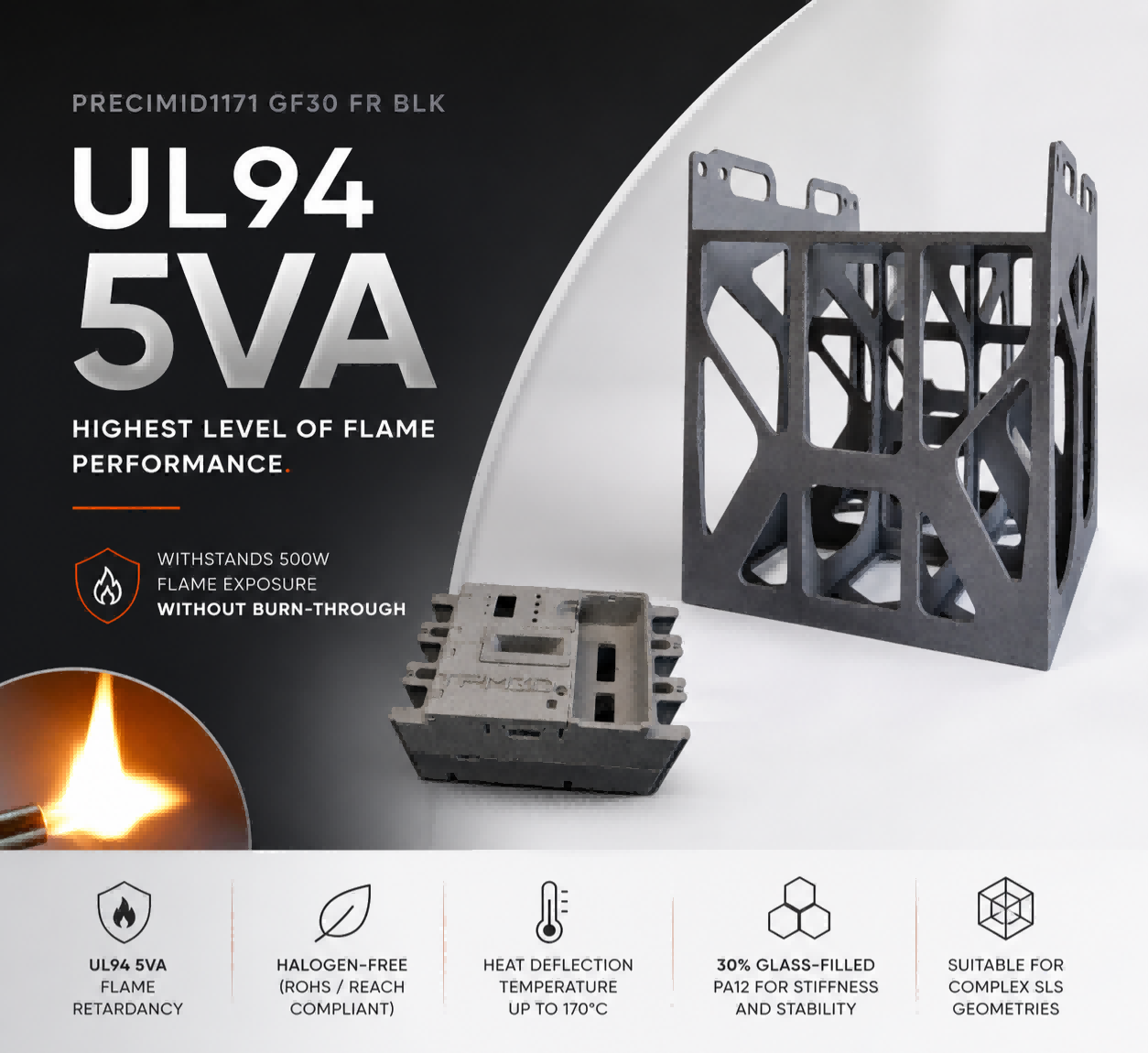
TPM3D has announced that its glass-filled nylon 12 powder, Precimid1171 GF30 FR BLK, used in selective laser sintering (SLS) additive manufacturing, has achieved a UL94 5VA rating, the highest classification in the UL 94 flammability standard for polymer materials.
The result represents a technical advancement for SLS 3D printing in applications requiring flame resistance, thermal stability, and regulatory compliance, including home appliances, electric vehicles (EVs), and automotive electronics.
SLS Materials in Safety-Critical Applications
SLS 3D printing is widely used for functional prototyping and low-volume production due to its tool-free workflow, ability to produce complex geometries, and relatively short iteration cycles.
However, in regulated industries, the adoption of polymer-based additive manufacturing has been limited by material constraints, particularly in flame-retardancy performance.
The UL94 5VA classification addresses this limitation by enabling additively manufactured polymer parts to meet the highest level of flame resistance defined in the UL 94 standard.
UL94 5VA: Definition and Test Conditions
The UL 94 standard is a widely used polymer flammability testing method. It classifies materials from HB through V-2, V-1, and V-0, with 5VB and 5VA representing the most stringent categories.
While V-0 evaluates self-extinguishing behavior, 5VA requires resistance to burn-through under a 500W flame test applied to flat specimens.
In simplified terms:
- V-0: material self-extinguishes within defined time limits
- 5VA: material does not burn through under high-energy flame exposure
This distinction is relevant for applications such as battery housings, high-voltage electrical components, and unattended electrical systems, where flame propagation must be minimized.
General Test Criteria (HB Horizontal Test | Applies to All Ratings)
| Test Condition | Burning Rate | Flammability Grade |
|---|---|---|
| Specimen thickness: 3–13 mm | ≤40 mm/min | HB |
| Specimen thickness: <3 mm | ≤75 mm/min | HB |
| Flame extinguishes before reference mark (25~100 mm gauge length) | =0 mm/min | HB |
Vertical Burning Test Criteria (V‑0 / V‑1 / V‑2 Vertical Flame Test)
| Test Condition | V‑0 | V‑1 | V‑2 |
|---|---|---|---|
| Afterflame time per single flame application (s) | ≤10 | ≤30 | ≤30 |
| Total cumulative afterflame time across 10 ignitions (s) | ≤50 | ≤250 | ≤250 |
| Combined afterflame + afterglow time post 2nd flame application (s) | ≤30 | ≤60 | ≤60 |
| Flaming drips ignite cotton indicator | No | No | Yes |
| Flame spreads to specimen clamp (full specimen burnout) | No | No | No |
High-Grade Vertical Test Criteria (5VA / 5VB High-Intensity Flame Test)
| Test Condition | 5VA | 5VB |
|---|---|---|
| Total afterflame + afterglow over 5 flame applications per specimen (s) | ≤60 | ≤60 |
| Flaming drips ignite cotton indicator | No | No |
| Full through-hole penetration on specimen (<3 mm thickness) | No | Yes |
Material Overview: Precimid1171 GF30 FR BLK
Precimid1171 GF30 FR BLK is a 30% glass fiber-reinforced PA12 powder designed for SLS additive manufacturing.
The material combines flame-retardant properties with mechanical reinforcement to achieve a balance of:
- stiffness
- thermal resistance
- dimensional stability
Key properties include:
- UL94 5VA flame retardancy
- Halogen-free formulation compliant with RoHS, REACH, and POPs requirements
- Heat deflection temperature up to 170°C (0.45 MPa)
- Compatibility with complex geometries produced via SLS without tooling
The material is intended for functional end-use parts in regulated industrial applications.
Precimid1171 GF30 FR BLK Specifications
| Mechanical properties | Test method | Metric |
| Part Color | Visual | Ash Black |
| Density | DIN 53466 | 1.25 g/cm³ |
| Elongation at break | ASTM D638 | 2.6% |
| Flexural strength | ASTM D790 | 63 MPa |
| Flexural modulus | ASTM D790 | 2,800 MPa |
| Heart Deflection temperature 0.45MPa | ASTM D648 | 170 ℃ |
| Heart Deflection temperature 1.82MPa | ASTM D648 | 133 ℃ |
| Tensile strength | ASTM D638 | 40 MPa |
| Tensile modulus | ASTM D638 | 3,500 MPa |
| IZOD impact strength with notch | ASTM D256 | 18 J/M |
| IZOD impact strength without notch | ASTM D256 | 82 J/M |
Regulatory Environment
Demand for flame-retardant engineering polymers continues to increase as regulatory requirements become more stringent.
In the European Union, relevant frameworks include:
- RoHS Directive restrictions on hazardous substances
- REACH regulation, including SVHC candidate listing exceeding 250 substances as of 2026
- Product safety requirements for electrical and electronic equipment
These regulations have increased requirements for material traceability, chemical compliance, and long-term thermal safety performance.
UL 94:2024 Test Results
Precimid1171 GF30 FR BLK was tested by third-party laboratories in accordance with UL 94:2024, using a 500W vertical flame test on 10 mm thick specimens.
Results include:
- total afterflame and afterglow time below 60 seconds
- no burn-through of specimens
- no ignition of cotton indicator material
The material meets the requirements for UL94 5VA classification.
Applications in Industrial Sectors
The combination of flame retardancy, glass fiber reinforcement, and SLS manufacturability enables use across several sectors:
Home appliances
Switches, connectors, motor housings, and structural components in heating and cooling systems.
Electric vehicles (EVs)
Battery pack internal structures, high-voltage relay housings, busbar insulation components, and charging system parts.
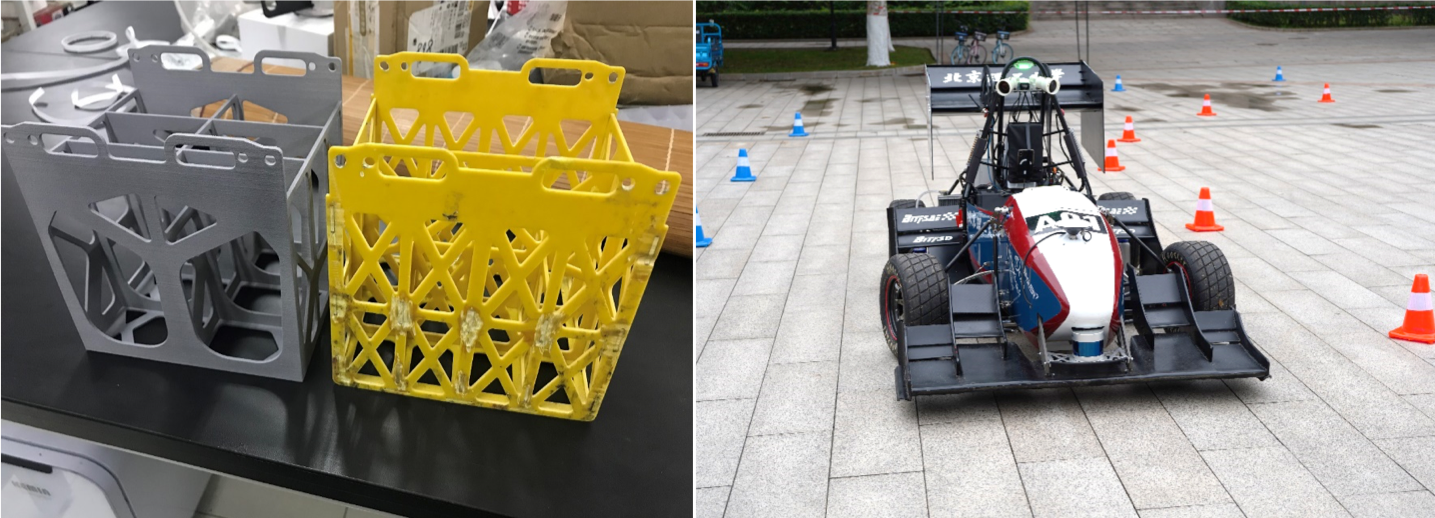
Automotive electronics
ECU housings, sensor enclosures, fuse boxes, and connector systems exposed to elevated temperatures.
Industrial equipment
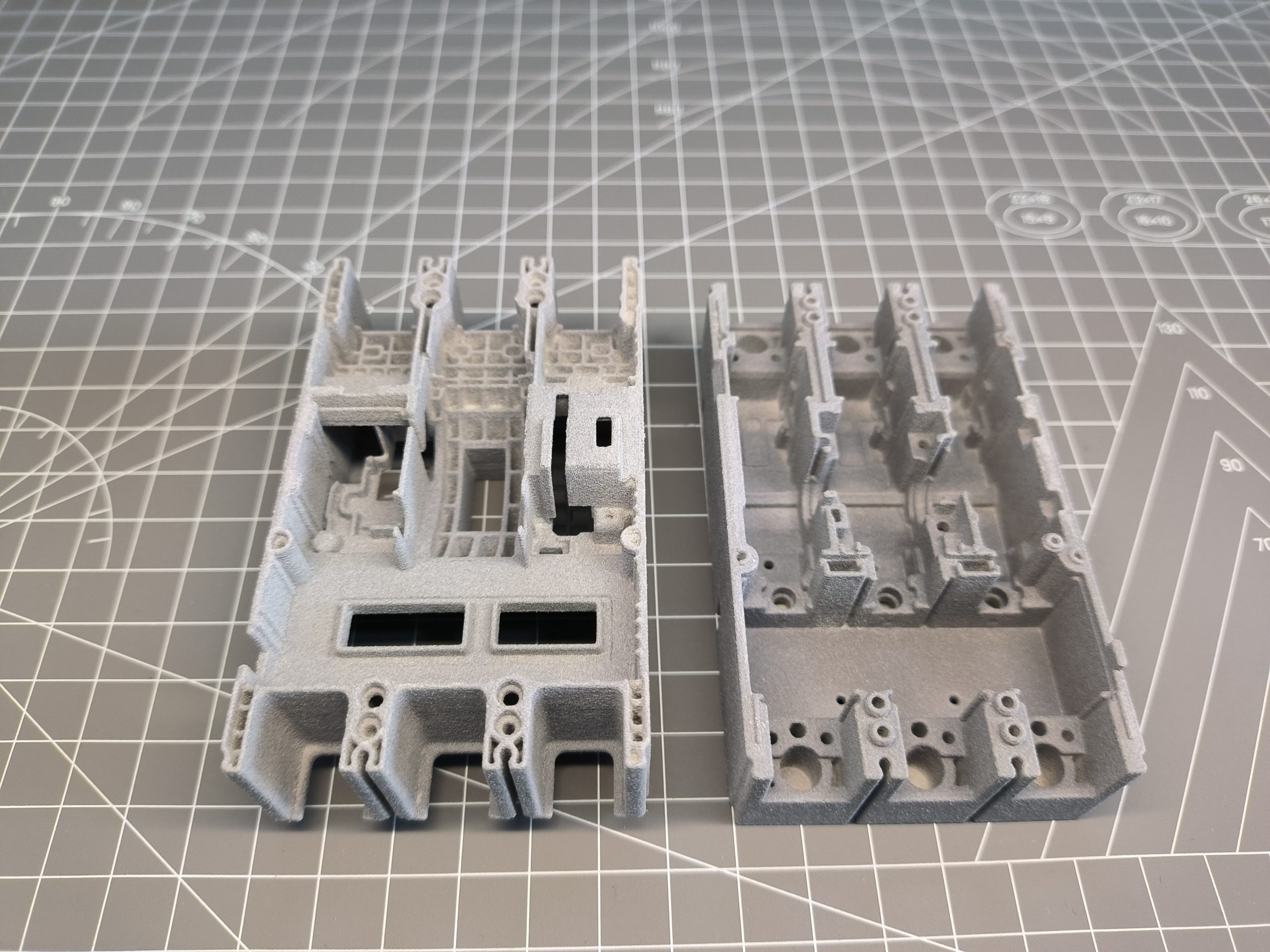
Circuit breaker housings, switchgear components, and insulation parts for low-volume production.
Aerospace applications
Lightweight interior components and functional prototypes requiring flame resistance.
SLS Manufacturing Considerations
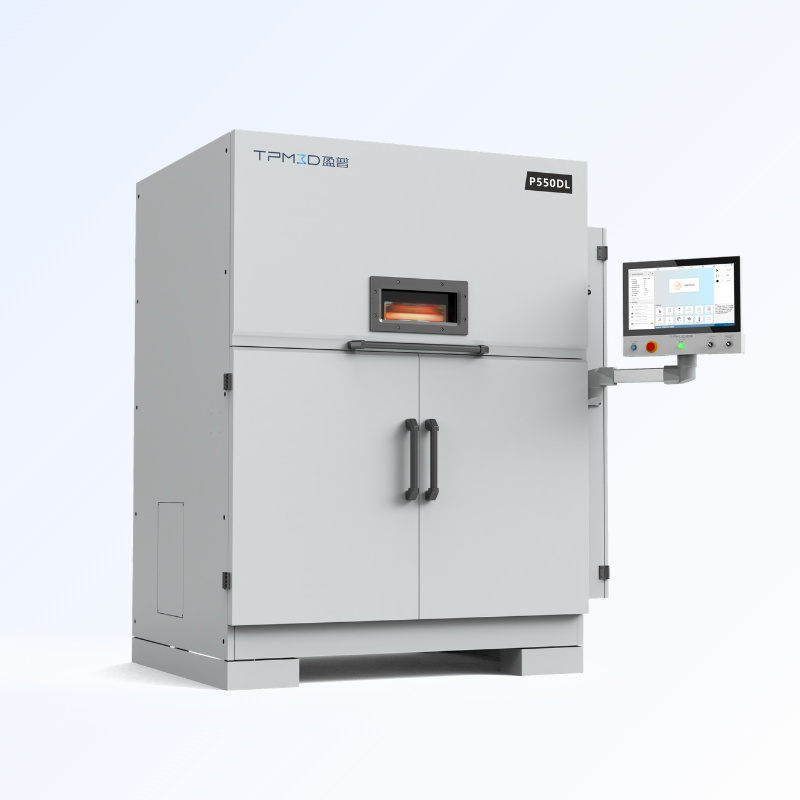
When used with TPM3D SLS systems such as the P360 platform, Precimid1171 GF30 FR BLK supports a workflow that eliminates tooling requirements.
Key advantages include:
- direct digital-to-part production (CAD to part)
- consolidation of complex geometries into single builds
- powder reusability to reduce material waste in low-volume production
Conclusion
The UL94 5VA classification extends the potential applications of SLS 3D printing to environments with strict flame safety requirements.
By combining glass fiber reinforcement, elevated thermal performance, and high-level flame resistance, Precimid1171 GF30 FR BLK enables the production of functional polymer components for regulated industries where safety performance is critical.
TPM3D continues to develop SLS material systems to support industrial additive manufacturing applications requiring validated mechanical and thermal performance.